
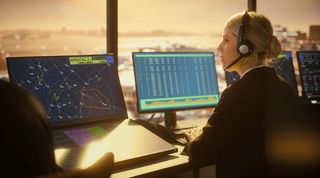
What collision simulation means in ATSA preparation
“Collision simulation” is a term often used by candidates and preparation resources to describe conflict-detection or movement-tracking tasks associated with ATSA preparation.
The ATSA, or Air Traffic Skills Assessment, is generally discussed as an aptitude-style assessment used in the FAA air traffic controller hiring process. Some preparation materials include tasks where candidates must observe moving objects, judge whether paths may conflict, and respond under time pressure.
Independent websites should not claim to reproduce the official ATSA or publish proprietary test content. A responsible way to approach collision simulation is to focus on the underlying skills: spatial judgment, visual attention, speed, accuracy, and calm decision-making.
Why this type of task matters
Air traffic control work involves monitoring movement, anticipating conflicts, and making decisions with safety in mind. ATSA-style collision simulation practice is not the same as real air traffic control, but it can help candidates practice relevant cognitive skills.
These tasks may involve abilities such as:
- tracking moving objects
- judging relative position
- estimating whether paths may intersect
- responding quickly to changing information
- following rules under pressure
- maintaining accuracy while the display is busy
- avoiding panic when several objects appear at once
The purpose of preparation is not to learn real separation standards. It is to become more comfortable with visual-spatial decision-making.
Collision simulation is not real ATC training
This point is important.
A collision simulation-style practice task is not the same as controlling aircraft. It does not teach professional air traffic control procedures, communications, phraseology, radar separation, or facility-specific operations.
It is a preparation category for aptitude-style testing.
Candidates should avoid confusing practice games or simulations with professional ATC training. FAA Academy and operational training are separate parts of the career path.
What these tasks usually test
Collision-style preparation tasks may test several skills at the same time.
Visual tracking
You may need to follow moving objects while keeping track of their direction, speed, or relationship to other objects.
Visual tracking becomes harder when multiple objects are present or when the display changes quickly.
Spatial reasoning
You may need to judge whether two paths are likely to come close, overlap, or create a conflict. This requires understanding movement and position, not just seeing objects on a screen.
Attention control
You may need to identify what matters and ignore distractions. A busy display can pull your attention away from the relevant object or rule.
Rule-following
The task may define what counts as a conflict or what response is required. Reading and applying the rule correctly is just as important as visual speed.
Time pressure
Timed responses can make the task feel more intense. Candidates may make mistakes not because they cannot see the situation, but because they rush or panic.
Error recovery
If you miss one item, you still need to continue. A single mistake should not cause you to lose focus for the rest of the task.
Common candidate challenges
Collision simulation-style tasks can feel difficult because they combine multiple demands at once.
Candidates often struggle with:
- looking at the wrong object
- reacting too early
- reacting too late
- misunderstanding the rule
- overestimating a conflict
- underestimating a conflict
- losing track of movement
- freezing when the screen becomes busy
- focusing on one object and missing another
- becoming anxious after one mistake
The challenge is not only visual. It is cognitive and emotional.
How to practice responsibly
You can prepare for collision simulation-style tasks without seeing official test content.
A responsible practice plan should train the underlying skills.
Start with slow visual tracking
Begin with simple movement tasks. Track one or two objects and describe their direction or relationship.
Do not start with the hardest simulation immediately. If you cannot understand the basic movement slowly, speed will only make errors worse.
Practice relative movement
Try to understand whether objects are moving toward each other, away from each other, parallel, or crossing.
The goal is to build comfort with motion and relative position.
Add rules
Once movement feels easier, add simple rules.
For example, a practice exercise may define when two paths should be considered a conflict. The exact rule does not need to match the official ATSA. It just needs to train rule-following under visual pressure.
Add timing
After you understand the task, add time limits.
Timing should be introduced gradually. If timing causes panic, reduce difficulty and rebuild.
Review your mistakes
After practice, ask why errors happened.
Did you:
- misread the rule?
- lose track of an object?
- respond too quickly?
- wait too long?
- focus on the wrong area?
- become anxious?
- confuse similar movements?
This review is where much of the improvement happens.
How to avoid overreacting
One common issue in conflict-style tasks is overreaction. Candidates may respond whenever objects look close, even if the task rule does not require a response.
To avoid this:
- read the rule carefully
- define what counts as a conflict
- avoid guessing based only on anxiety
- respond to the task, not to your fear
- practice waiting just long enough to make a decision
- review false alarms after practice
Good performance is not only speed. It is speed with judgment.
How to avoid underreacting
The opposite problem is underreaction. Some candidates wait too long because they want certainty before responding.
To reduce underreaction:
- practice recognizing early indicators
- use the task rules to guide decisions
- avoid staring at one object too long
- scan the display systematically
- accept that timed tasks require decisions before perfect comfort
- build confidence through repeated practice
A good response style is neither impulsive nor frozen.
Scanning strategy
A useful scanning strategy can make these tasks feel more manageable.
Instead of staring randomly, practice a pattern:
- Identify the objects that matter
- Note direction of movement
- Check whether paths may interact
- Apply the rule
- Respond if needed
- Reset your attention for the next situation
The exact strategy depends on the task, but the principle is consistent: scan with purpose.
Speed vs accuracy
Collision simulation-style tasks often create a speed-accuracy tradeoff.
If you move too slowly, you may miss the window to respond. If you move too quickly, you may create false alarms.
During practice, track both:
- missed conflicts
- false alarms
- late responses
- rule errors
- attention lapses
Do not measure improvement by speed alone. The goal is accurate, rule-based responses under pressure.
What not to do
Avoid these mistakes:
- searching for secret official simulation content
- assuming every online simulation matches the real ATSA
- practicing only easy tasks
- ignoring timing
- ignoring false alarms
- panicking after a single miss
- confusing practice games with real ATC training
- trying to memorize display patterns
- skipping the instructions
- focusing only on speed
The best preparation is skill-focused and honest about its limits.
How collision simulation connects to other ATSA skills
Collision-style tasks overlap with several other ATSA preparation areas.
Spatial reasoning
You need to understand movement, direction, and relative position.
Attention
You need to identify relevant information while ignoring distractions.
Working memory
You may need to remember the task rule or recent information while watching movement.
Multitasking
You may need to monitor several objects or demands at once.
Decision-making
You need to decide when a response is required and when it is not.
This is why collision simulation practice can feel mentally demanding even when the screen looks simple.
Suggested practice routine
Use this practice sequence if collision-style tasks feel unfamiliar.
Session 1 - Movement basics
Practice tracking simple moving objects without timing. Focus on direction, relative position, and whether paths are approaching or separating.
Session 2 - Rule application
Add a simple rule for what counts as a conflict. Practice slowly and focus on understanding the rule.
Session 3 - Timed responses
Use short timed sets. Track accuracy and false alarms.
Session 4 - Busy displays
Add more objects or distractions. Keep sessions short so fatigue does not destroy accuracy.
Session 5 - Mixed practice
Combine collision-style practice with attention, memory, or multitasking drills. This helps build flexibility.
This routine does not recreate the official ATSA. It helps train relevant skills responsibly.
Test-day mindset
If you encounter conflict-detection or movement-tracking tasks on test day, focus on the task instructions in front of you.
Use this mindset:
- read the rule first
- do not assume the task works like a practice tool
- stay calm if the display feels busy
- prioritize accuracy with timing
- recover quickly after mistakes
- avoid guessing based only on stress
- keep following the instructions exactly
Do not let one difficult task define your whole test experience.
How commercial prep products often label this skill
Editors sometimes group conflict-style tasks under names like Air Traffic Collision Scenarios in third-party ATSA suites (for example the ATCPrep.com™ module set listed on SkyTest). Typical drills combine:
- sector-style displays where you monitor several moving targets
- judgments about whether paths will conflict or stay separated
- mental arithmetic alongside the visual task (distances, speeds, or timing estimates)
- short timed bursts that reward calm accuracy over frantic clicking
These labels are not FAA or Pearson VUE section titles. They help you compare products: if a vendor markets “collision scenarios,” expect overlapping skills with the spatial, attention, and multitasking preparation on this page-not a 1:1 clone of any official item bank.
Bottom line
Collision simulation-style ATSA preparation is about visual-spatial judgment, attention, rule-following, and calm decisions under pressure.
You do not need proprietary official content to practice these skills. Use honest preparation tasks, review mistakes, build timing gradually, and remember that practice simulations are not real air traffic control training.
For broader preparation, continue with ATSA question types explained and How to prepare for the ATSA.
Optional vendor shortcuts (commercial)
If you want optional paid prep aligned with this page topic, compare these options:
- ATSA Practice Tests
- Multitasking-focused drills: JobTestPrep ATSA course and ATC Preparation FEAST software
- JobTestPrep ATSA course
- ATC Preparation ATSA software
- ATC Preparation ATSA personality test
- JobTestPrep ATC aptitude catalog
Use review-first comparison: Best ATSA Practice Tests, ATSA Practice Tests Review, JobTestPrep ATSA Review, ATC Preparation Review, and SkyTest Review.
Preparation resources
Free resources are a good starting point if you are still learning the format. If you add paid material later, compare calmly and read refund rules on the publisher’s site.
For ATSA-only commercial practice, start with ATSA Practice Tests. The vendor publishes 10 ATSA-aligned training modules, timed Full Simulations, and a Performance Center, with a one-time 90-day access window. Confirm live pricing, access terms, and refund rules on the vendor site. It is independent and not affiliated with the FAA.
If your research widens beyond the FAA pathway, these third-party catalogs may still be worth a quick skim (none are official FAA, Pearson VUE, or USAJOBS materials): FEAST-style practice content, NAV CANADA-oriented prep, and notes aimed at later FEAST stages. Publisher: JobTestPrep.
For interactive ATSA-style training, you may also review ATC Preparation ATSA software and our ATC Preparation Review. Verify pathway fit on the vendor site before purchasing.
If your research widens to FEAST pathways, see our SkyTest Review and SkyTest® products: European ATCO screenings, UK & Ireland, and Germany, Austria & Switzerland - none are official FAA materials.
You can also compare paid products using our ATSA Practice Tests Review, JobTestPrep ATSA Review, Best ATSA Practice Tests, and the Reviews hub.