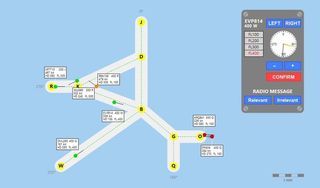
What is FEAST MULTI-PASS?

FEAST MULTI-PASS is commonly discussed by candidates as a multitasking-style task associated with FEAST preparation.

FEAST, the First European Air Traffic Controller Selection Test, is a EUROCONTROL-developed test battery used by participating air navigation service providers, academies, and training organizations. MULTI-PASS is often discussed in connection with later FEAST-style task performance, especially preparation for complex multitasking and workload management.

Because official FEAST content is controlled by the testing organizations, candidates should be careful with claims about the exact MULTI-PASS format. This page explains the broad preparation concepts ethically, without claiming to reproduce the official test.

What MULTI-PASS is designed to assess

MULTI-PASS-style preparation is usually about managing several tasks at once while staying accurate.

It may involve abilities such as:

  • multitasking
  • divided attention
  • sustained attention
  • prioritization
  • rule application
  • working memory
  • visual monitoring
  • speed and accuracy
  • decision-making
  • workload control
  • error recovery
  • stress management

The main challenge is not one single difficult question. The challenge is keeping several task demands under control at the same time.

MULTI-PASS and FEAST Part 2

MULTI-PASS is most naturally connected with FEAST Part 2, or FEAST II, because FEAST II is commonly associated with more complex multitasking tasks.

Where FEAST Part 1 may test foundational cognitive abilities, FEAST Part 2 may require candidates to combine those abilities in a more demanding task environment.

Related pages:

MULTI-PASS is not real ATC work

MULTI-PASS may feel more operational than ordinary aptitude questions, but it is not the same as working as a certified air traffic controller.

You generally do not need to know real ATC phraseology, separation rules, facility procedures, or radar control techniques before taking FEAST unless your recruiting organization specifically tells you otherwise.

The task is better understood as an assessment of relevant abilities:

  • Can you monitor several things?
  • Can you apply rules consistently?
  • Can you prioritize?
  • Can you stay calm when workload increases?
  • Can you avoid tunnel vision?
  • Can you recover after a mistake?

That is what you should prepare for.

Why MULTI-PASS feels difficult

MULTI-PASS-style tasks can feel difficult because they overload weak habits.

Candidates may struggle when they:

  • focus on one task and forget another
  • react too quickly without checking rules
  • lose track of priorities
  • panic when several events happen at once
  • forget instructions after the task starts
  • make one mistake and then spiral
  • stop scanning the full display
  • respond to low-priority items before urgent ones
  • become too slow because they overcheck everything

The task rewards controlled attention, not frantic activity.

Core skill 1: multitasking

Multitasking is the central MULTI-PASS skill.

In this context, multitasking means managing multiple information streams in a structured way. It does not mean randomly jumping between tasks.

Good multitasking involves:

  • knowing the rules
  • knowing what matters most
  • checking the right information at the right time
  • responding without hesitation
  • not forgetting secondary tasks
  • staying aware of the whole display
  • avoiding overfocus on one item

A useful preparation goal is to develop a repeatable scanning rhythm.

Core skill 2: prioritization

Prioritization means deciding what needs attention first.

In MULTI-PASS-style tasks, not every event may have the same importance. Some items may be more urgent, more risky, or more relevant than others.

Prioritization may depend on:

  • time remaining
  • distance
  • direction
  • risk level
  • rule hierarchy
  • type of alert
  • whether an item is changing
  • whether a response is required now
  • whether another task can wait

A common candidate mistake is responding to the most visually obvious item instead of the most important item.

Core skill 3: rule application

MULTI-PASS-style tasks may require you to apply several rules quickly.

Rules may define:

  • when to act
  • when not to act
  • what action to choose
  • which items have priority
  • which exceptions override normal rules
  • how to respond to different categories
  • what counts as an error

The challenge is maintaining rule accuracy after workload increases.

If you understand a rule during instructions but forget it during performance, your preparation should include working memory and rule-retention drills.

Core skill 4: working memory

Working memory helps you hold task rules, values, priorities, and recent events in mind.

In a multitasking task, you may need to remember:

  • current priorities
  • previous changes
  • active rules
  • pending tasks
  • which items were already handled
  • what needs to be checked again
  • which warnings matter
  • which response belongs to which condition

Weak working memory can make multitasking collapse quickly.

Related page: FEAST memory test

Core skill 5: visual monitoring

MULTI-PASS-style performance may require continuous visual monitoring.

You may need to watch:

  • symbols
  • changing values
  • moving items
  • alerts
  • categories
  • positions
  • labels
  • timing indicators
  • task status

The risk is tunnel vision. If you stare at one area too long, you may miss important changes elsewhere.

Related page: FEAST attention test

Core skill 6: workload control

Workload control means staying functional when the task becomes busy.

Good workload control includes:

  • keeping a steady pace
  • scanning consistently
  • avoiding panic
  • prioritizing correctly
  • ignoring irrelevant information
  • responding accurately
  • not overchecking
  • recovering after mistakes
  • continuing even when the display feels busy

Air traffic selection tasks often reward candidates who remain stable under pressure.

How to prepare for FEAST MULTI-PASS

Preparation should be progressive.

Do not start with the most complex multitasking drills immediately. Build from simple control to complex performance.

A good progression is:

  1. Practice visual attention.
  2. Practice simple rule application.
  3. Practice working memory.
  4. Add two tasks at once.
  5. Add priority rules.
  6. Add time pressure.
  7. Add dynamic changes.
  8. Review mistakes.
  9. Repeat with harder variations.
  10. Complete mixed timed sessions.

The goal is controlled multitasking, not chaotic speed.

Step 1: practice simple attention

Start with basic attention drills.

Examples:

  • find target symbols
  • count specific items
  • compare similar shapes
  • detect changes
  • ignore distractors
  • identify relevant values

Focus first on accuracy. Then add timing.

If your visual scanning is weak, multitasking will be harder.

Step 2: practice rule-based responses

Next, practice applying simple rules.

Example:

If the number is even, press A.
If the number is odd, press B.
If the number is 5, press C instead.

This trains rule hierarchy and exception handling.

As you improve, add more rules or reduce the time available.

Step 3: practice dual-task exercises

Once you can handle simple rules, add a second task.

Example:

  • Task 1: count every target symbol
  • Task 2: respond when a number exceeds a threshold

The goal is to keep both tasks active.

A common mistake is doing one task well while completely forgetting the other.

Step 4: add priority

After dual-task practice, add priority rules.

Example:

Red alerts must be handled before blue alerts.
If two alerts appear together, handle the one with less time remaining.
If a red alert is already handled, return to the monitoring task.

Priority rules train decision-making under competing demands.

Step 5: add dynamic changes

Next, add movement or changing information.

Practice:

  • tracking moving dots
  • monitoring changing values
  • detecting when two paths converge
  • identifying objects that cross a boundary
  • responding to changing priorities
  • updating decisions as new information appears

Dynamic changes make the task more realistic and more demanding.

Step 6: add timed pressure

Timing should be added gradually.

Use this progression:

  1. Learn the task untimed.
  2. Practice for accuracy.
  3. Add a generous timer.
  4. Reduce the time.
  5. Increase the number of items.
  6. Add more rules.
  7. Mix task types.
  8. Review errors.

Do not train panic. Train controlled speed.

Step 7: practice recovery after errors

Mistakes happen in complex tasks.

Practice recovering quickly.

After an error:

  • do not freeze
  • do not rush randomly
  • return to the current task
  • reapply the rules
  • continue scanning
  • protect the next response

A single error should not become a chain of errors.

Sample MULTI-PASS-style practice concept

This is not an official FEAST task. It is only a simplified training example.

Instructions

You are monitoring two tasks:

Task A: Count every X.
Task B: Press ALERT whenever a number is greater than 7.
Priority rule: If a number greater than 7 appears immediately after X, handle the number first, then continue counting X.

Sequence:

X  3  X  9  Y  8  X  4  2  X

Correct result

X count = 4
ALERT responses = 2

Numbers greater than 7:

9, 8

What this trains

This trains divided attention, rule application, and priority handling.

Harder versions can add more symbols, time limits, moving objects, or changing rules.

MULTI-PASS preparation mistakes

Avoid these mistakes:

  • practicing only isolated aptitude questions
  • ignoring multitasking until the last day
  • trying to memorize unofficial task descriptions
  • rushing before understanding the rules
  • failing to review mistakes
  • focusing on one task and ignoring others
  • losing track of priority rules
  • overchecking every item
  • panicking after one error
  • assuming practice software is identical to the official test
  • using leaked or unauthorized material

Good preparation trains flexible performance.

How to review MULTI-PASS mistakes

After each practice session, identify the cause of each error.

Ask:

  • Did I forget a rule?
  • Did I miss a visual change?
  • Did I focus on one area too long?
  • Did I respond too quickly?
  • Did I respond too slowly?
  • Did I ignore priority?
  • Did I lose track of a secondary task?
  • Did I misunderstand the instruction?
  • Did I panic after a mistake?
  • Did fatigue reduce performance?

Then choose the next drill based on the weakness.

Building a scanning rhythm

A scanning rhythm helps you avoid tunnel vision.

A simple rhythm might be:

  1. Check primary task.
  2. Check secondary task.
  3. Check for priority items.
  4. Respond if needed.
  5. Return to primary task.
  6. Repeat.

The exact rhythm depends on the task, but the principle is the same: do not let your attention drift randomly.

Speed vs accuracy in MULTI-PASS

Speed matters, but accuracy controls the value of speed.

A fast response that violates the rule is not useful.

During preparation, aim for:

  • accurate understanding first
  • steady rhythm second
  • faster response third

If your accuracy collapses when you speed up, slow down and rebuild control.

MULTI-PASS and stress

MULTI-PASS-style tasks may feel stressful because they create workload pressure.

Stress can cause:

  • rushed responses
  • shallow instruction reading
  • forgotten rules
  • tunnel vision
  • panic clicking
  • overchecking
  • freezing
  • frustration after errors

Practice should include stress tolerance. Timed mixed drills can help, but only if you review mistakes calmly afterward.

MULTI-PASS and English comprehension

Even if the task is visual or dynamic, English may still matter.

You may need to understand:

  • task instructions
  • rule conditions
  • exceptions
  • priority wording
  • labels
  • warnings
  • timing instructions
  • result messages

Important words include:

  • before
  • after
  • unless
  • except
  • greater than
  • less than
  • only if
  • ignore
  • first
  • priority
  • immediate

If English is not your strongest language, practice instruction reading under time pressure.

Related page: FEAST English test

One-week MULTI-PASS preparation plan

If you have one week, focus on task control.

Day 1: understand multitasking

Read about FEAST Part 2 and MULTI-PASS concepts.

Day 2: visual attention

Practice target detection and visual scanning.

Day 3: rule application

Practice rules, exceptions, and quick responses.

Day 4: dual-task practice

Combine two simple tasks.

Day 5: prioritization

Add urgency and priority rules.

Day 6: timed mixed practice

Complete a timed session and review mistakes.

Day 7: light review

Rest, review instructions, and protect sleep.

Two-week MULTI-PASS preparation plan

If you have two weeks, build progressively.

Days 1–2: foundation

Practice attention, reaction accuracy, and rule reading.

Days 3–5: dual-task control

Practice monitoring two tasks at once.

Days 6–8: priority and exceptions

Add priority rules and exception handling.

Days 9–11: dynamic monitoring

Practice moving objects, changing values, and visual prediction.

Days 12–13: timed simulations

Complete mixed timed practice and review errors.

Day 14: recovery

Light practice, logistics, and rest.

How MULTI-PASS connects to ATC skills

MULTI-PASS-style tasks are relevant to ATC selection because air traffic control requires controlled multitasking.

Controllers must often:

  • monitor several aircraft
  • follow procedures
  • prioritize conflicts
  • communicate clearly
  • update decisions quickly
  • manage workload
  • stay calm under pressure
  • recover from errors
  • maintain situational awareness

A selection task does not need to copy real ATC work exactly to assess relevant abilities.

What not to expect

Do not expect MULTI-PASS preparation to teach you actual air traffic control.

It should not be treated as:

  • radar controller training
  • separation-standard training
  • phraseology training
  • facility procedure training
  • pilot communication training
  • a copy of the real FEAST test

It is preparation for cognitive and multitasking demands.

Ethical preparation

Prepare ethically.

Avoid:

  • leaked official FEAST content
  • screenshots from real tests
  • copied confidential materials
  • unauthorized question banks
  • claims of exact official replication
  • sharing protected test details after your session

Use practice to improve abilities, not to bypass the selection process.

What to verify officially

Before taking FEAST or any FEAST-related stage, verify:

  • whether you are invited to the relevant stage
  • test date
  • test location or delivery method
  • expected duration
  • required identification
  • allowed and prohibited items
  • whether breaks are included
  • result communication process
  • retake policy
  • contact information for questions

If this guide conflicts with your ANSP, recruiter, academy, university, EUROCONTROL, or test-session instructions, follow the official source.

Bottom line

FEAST MULTI-PASS is commonly discussed as a complex multitasking-style task concept. It is best prepared for by training divided attention, prioritization, rule application, working memory, visual monitoring, workload control, and recovery after mistakes.

Do not try to memorize unofficial descriptions. Build the underlying skills, practice under time pressure, review errors carefully, and follow official instructions from the organization that invited you.

Preparation resources

FEAST 2, DART, and MULTI-PASS stages differ by employer. Paid prep only helps when it mirrors what you were actually invited to complete.

From the same commercial catalog you may still cross-check: FEAST-style practice, EUROCONTROL-oriented FEAST prep, and NAV CANADA–oriented prep. Publisher: JobTestPrep.

You may also find our JobTestPrep FEAST Review helpful before purchasing.

Frequently asked questions

Comparing paid prep (optional)

For later-stage FEAST research, you may open FEAST 2–oriented notes or general ATC aptitude pages from JobTestPrep. Confirm fit with your selection stage before buying.

What is FEAST MULTI-PASS?

FEAST MULTI-PASS is commonly discussed as a multitasking-style FEAST task concept associated with complex attention, prioritization, and workload control.

Is MULTI-PASS part of FEAST Part 2?

It is commonly discussed in connection with FEAST Part 2-style preparation, but candidates should verify their exact test process with the organization that invited them.

What does MULTI-PASS test?

It may train or assess multitasking, divided attention, rule application, prioritization, working memory, visual monitoring, and performance under pressure.

Is MULTI-PASS real air traffic control?

No. It may involve ATC-relevant skills, but it is not the same as working as a certified controller.

How should I prepare for MULTI-PASS?

Practice visual attention, rule application, dual-task exercises, prioritization, dynamic monitoring, timed mixed drills, and mistake recovery.

Should I memorize MULTI-PASS examples?

No. Memorizing examples is less useful than building flexible multitasking skills.

Are online MULTI-PASS practice tools identical to FEAST?

Not necessarily. Treat practice tools as preparation for task concepts, not as exact copies of the official test.