
Understanding the NAV CANADA Tower Controller Role
A NAV CANADA tower controller is an air traffic controller who works in an airport control tower and helps manage aircraft and vehicle movement in the airport environment. Tower control is one of the most visible forms of air traffic control because it is closely connected to runways, taxiways, departures, arrivals, and airport surface activity.
For candidates, the tower controller role can be attractive because it combines aviation, real-time decision-making, communication, visual awareness, and safety-critical responsibility. However, it is also demanding. Tower controllers must stay alert, communicate clearly, manage changing traffic situations, and apply procedures accurately under time pressure.
This guide explains the tower controller role in general terms. It is not an official NAV CANADA job description, training manual, or selection document. Exact responsibilities, training steps, qualification rules, and work conditions can vary by facility, role, and official NAV CANADA requirements.
What Does a Tower Controller Do?
A tower controller helps manage aircraft and vehicle movement at or near an airport. Depending on the airport, traffic volume, weather, runway layout, and operational structure, tower controllers may handle different positions or responsibilities.
Tower controller work may involve:
- monitoring aircraft and vehicle movement;
- issuing clearances or instructions according to applicable procedures;
- coordinating runway use;
- sequencing arriving and departing aircraft;
- managing taxiway and airport surface activity;
- communicating with pilots and vehicle operators;
- coordinating with other air traffic services units;
- monitoring weather and visibility conditions;
- maintaining situational awareness;
- prioritizing safety and efficiency.
The exact tasks depend on the facility and the controller’s qualification. Candidates should not assume that every tower has the same traffic volume, complexity, or operational environment.
Tower Control vs. Area Control
Candidates often compare tower control with area control. Both are air traffic control roles, but the operational environment is different.
A tower controller usually works with the airport environment: runways, taxiways, aircraft taking off and landing, aircraft in the local control area, and vehicle movement on controlled surfaces.
An area controller usually works in an area control centre and manages aircraft across larger volumes of controlled airspace. Area control may involve radar or procedural control concepts, sector coordination, route management, altitude changes, and traffic flow over a wider region.
For comparison, see NAV CANADA area controller.
Neither role is automatically easier. They require different forms of attention, communication, spatial awareness, and workload management.
Tower Control vs. Flight Service Specialist
Tower controller and flight service specialist roles are also different. A tower controller provides air traffic control service in the applicable airport environment, while a flight service specialist may provide services such as flight information, airport advisory service, weather information, and operational support depending on stream and location.
Candidates should not assume that flight service specialist training, salary, responsibilities, or qualification requirements are identical to tower controller roles.
For a role-specific comparison, see NAV CANADA flight service specialist.
Key Skills for Tower Controllers
Tower control requires a combination of cognitive, communication, and professional skills.
Visual Scanning
Tower controllers may need to monitor aircraft, vehicles, runways, taxiways, and changing visual conditions. Strong visual scanning helps controllers maintain awareness of what is happening across the airport environment.
Good visual scanning involves:
- checking relevant areas repeatedly;
- noticing changes quickly;
- avoiding fixation on one movement;
- using visual cues accurately;
- maintaining awareness during busy periods.
Communication
Tower controllers must communicate clearly and efficiently. Radio communication must be concise, accurate, and unambiguous.
Important communication habits include:
- speaking clearly;
- listening carefully;
- avoiding unnecessary words;
- confirming important information;
- using correct terminology;
- staying calm under pressure.
For broader language expectations, see NAV CANADA language requirements.
Situational Awareness
Situational awareness means understanding what is happening now, what is likely to happen next, and what requires attention. In a tower environment, this can involve aircraft position, runway status, taxi routes, weather changes, traffic sequence, and coordination with other units.
Weak situational awareness can lead to missed information or delayed decisions. Strong situational awareness allows a controller to anticipate rather than only react.
Prioritization
Tower controllers may need to manage competing tasks. A controller must know which information is urgent, which task can wait, and how to keep the operation safe and organized.
Prioritization may involve:
- runway activity;
- aircraft on final approach;
- aircraft ready for departure;
- vehicles operating near movement areas;
- weather changes;
- coordination requests;
- pilot readbacks;
- unexpected events.
Decision-Making
Tower control requires timely decisions. A controller must evaluate information quickly, apply procedures, and communicate decisions clearly.
Strong decision-making is not impulsive. It is based on rules, safety priorities, current information, and professional judgement.
Stress Tolerance
Busy traffic periods, weather changes, equipment issues, or unexpected events can increase workload. Tower controllers must remain calm enough to communicate, prioritize, and apply procedures correctly.
Stress tolerance does not mean never feeling pressure. It means continuing to perform safely and clearly when pressure exists.
Tower Controller Selection
Candidates interested in tower control usually need to pass the broader NAV CANADA selection process. This may include application screening, aptitude testing, interviews, medical review, background checks, and training selection.
Relevant stages include:
- NAV CANADA application process;
- NAV CANADA online assessment;
- NAV CANADA FEAST test;
- NAV CANADA assessment centre;
- NAV CANADA interview.
The exact process may vary by recruitment campaign, region, stream, and NAV CANADA’s operational needs.
Aptitude Areas Relevant to Tower Control
Tower control selection may evaluate cognitive abilities that are useful in the airport environment. These skills may also be tested through broader air traffic control aptitude assessments.
Relevant aptitude areas include:
- attention control;
- working memory;
- visual scanning;
- spatial awareness;
- multitasking;
- mental arithmetic;
- rule application;
- reaction control;
- prioritization;
- communication under pressure.
For preparation guidance, see NAV CANADA test prep, NAV CANADA practice test, and NAV CANADA sample questions.
Practice should train underlying abilities, not attempt to reproduce official NAV CANADA testing.
Tower Controller Training
A selected tower controller candidate may need to complete multiple training phases before qualification. The exact structure can vary, but it may include basic training, simulation, facility-specific instruction, and on-the-job training.
Relevant training guides include:
Tower controller training may develop skills such as:
- airport layout awareness;
- runway and taxiway operations;
- traffic sequencing;
- visual scanning;
- radio communication;
- coordination;
- applying procedures under workload;
- responding to changing weather and traffic conditions.
A training offer should not be treated as full qualification. Candidates must meet required standards before becoming operationally qualified.
What Makes Tower Control Difficult?
Tower control can be difficult because the work combines visual awareness, radio communication, time pressure, procedures, and changing airport conditions.
Common challenges may include:
- monitoring several movements at once;
- maintaining runway awareness;
- handling busy departure or arrival periods;
- communicating clearly when workload is high;
- adapting to weather changes;
- coordinating with other positions or units;
- avoiding distraction;
- recovering quickly after mistakes;
- applying procedures consistently.
The difficulty is not only technical. It also involves calm performance, attention discipline, and professional judgement.
Working Environment
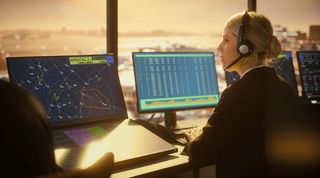
Tower controllers usually work in an airport control tower. The environment may include large windows, communication equipment, displays, coordination tools, and a direct view of airport movement areas.
The work environment may vary depending on airport size and traffic complexity. A major airport tower may feel different from a smaller regional tower. Traffic mix, runway layout, weather patterns, and operational tempo can all affect the job.
Candidates should also consider that air traffic services may involve shift work, weekends, holidays, early mornings, nights, or rotating schedules depending on facility needs.
Salary Considerations
Tower controller compensation may differ from trainee pay and may depend on qualification, facility, premiums, collective agreements, and official pay rules.
Candidates should not assume that a published salary range applies immediately after selection. Trainee salary, qualified controller salary, premiums, and location-based considerations should be reviewed separately.
For more context, see NAV CANADA salary.
Original Practice Exercises for Tower Controller Skills
The following examples are original and unofficial. They are not NAV CANADA test questions, not official training tasks, and not reproductions of protected assessment content. They are included only to show the types of skills that may be useful.
Exercise 1: Visual Scanning
Create a grid of letters and numbers. Set a timer for 60 seconds and count only one target symbol while ignoring similar symbols.
Skill trained: attention and visual discrimination.
Exercise 2: Sequence Management
Write down five aircraft labels, each with a different direction and priority. Practice arranging them in a safe and logical order based on simple rules you create.
Skill trained: prioritization and sequencing.
Exercise 3: Communication Brevity
Take a long instruction and rewrite it in the fewest clear words possible without losing meaning.
Skill trained: concise communication.
Exercise 4: Memory Under Interference
Memorize a short sequence of runway-style labels or numbers. Complete a simple arithmetic task, then recall the sequence.
Skill trained: working memory and resistance to distraction.
Exercise 5: Rule Application
Create three simple rules for responding to different symbols. Practice applying them quickly while the symbols change.
Skill trained: procedural accuracy and decision-making.
These exercises are useful because they build transferable skills without using protected content.
How to Prepare for a Tower Controller Pathway
Preparation should be broad and ethical. Candidates should build the skills needed for selection and training rather than searching for exact official questions.
A useful preparation plan may include:
- mental arithmetic practice;
- visual scanning drills;
- working memory exercises;
- spatial reasoning tasks;
- multitasking practice;
- concise speaking exercises;
- interview preparation;
- research into tower control work;
- sleep and stress management routines.
For the full preparation cluster, see:
Ethical Preparation: Skills, Not Leaked Content
Candidates should avoid any source claiming to provide real NAV CANADA tower controller test questions, protected training exercises, confidential tower scenarios, official screenshots, or internal procedures.
Do not use:
- leaked assessment questions;
- copied radio scenarios from protected materials;
- confidential training documents;
- official simulator screenshots;
- internal evaluation sheets;
- unauthorized recordings.
Ethical preparation focuses on transferable skills:
- attention;
- memory;
- communication;
- situational awareness;
- prioritization;
- spatial reasoning;
- workload management;
- stress control.
The goal is to become better prepared for selection and training, not to memorize protected content.
Common Mistakes Candidates Make
Thinking Tower Control Is Only Looking Out a Window
Visual awareness is important, but tower control also requires communication, procedures, coordination, decision-making, and workload management.
Underestimating Communication
Clear radio communication is central. Candidates should practice concise and accurate speech.
Assuming Tower Control Is Easier Than Area Control
Tower and area control are different. Each has its own complexity and training demands.
Preparing Only With Aviation Trivia
Aviation interest is helpful, but selection often focuses on aptitude, communication, trainability, and professional behaviour.
Ignoring Shift Work
Tower controllers may work schedules that include nights, weekends, holidays, or rotating shifts depending on facility needs.
Looking for Leaked Scenarios
Protected test or training content should not be used. Prepare with original skill-based practice.
Treating Training as Guaranteed
A training offer is not the same as qualification. Training performance matters.
What to Verify Officially
Before applying for or accepting a tower controller pathway, verify current details through NAV CANADA. Confirm:
- current eligibility requirements;
- whether tower controller roles are included in the recruitment campaign;
- application steps;
- assessment format;
- language requirements;
- medical requirements;
- background check requirements;
- training location;
- training duration estimate;
- whether placement is guaranteed or assigned;
- trainee salary and qualified salary;
- shift and schedule expectations;
- qualification standards;
- what happens if training is not completed.
Official NAV CANADA instructions should always take priority over unofficial guides.
Bottom Line
A NAV CANADA tower controller works in the airport control tower environment and helps manage aircraft and vehicle movement safely and efficiently. The role requires visual scanning, communication, situational awareness, prioritization, decision-making, and calm performance under pressure.
Candidates should understand how tower control differs from area control and flight service specialist work before applying. Preparation should focus on aptitude, communication, professionalism, and training readiness.
Do not use leaked questions, protected scenarios, or confidential training content. Practice the underlying skills ethically and verify all current requirements through NAV CANADA.
Optional vendor shortcuts (commercial)
If you want optional paid prep aligned with this page topic, compare these options:
- JobTestPrep NAV CANADA prep
- JobTestPrep FEAST practice
- ATC Preparation FEAST software
- ATC Preparation FEAST English prep
- SkyTest FEAST European ATCO
Use review-first comparison: JobTestPrep FEAST Review, ATC Preparation Review, and SkyTest Review.
Preparation resources
Independent orientation should not rely on leaked items. If you add paid practice, confirm alignment with NAV CANADA instructions first.
You may still compare these catalog areas from the same publisher (none are official NAV CANADA materials): FAA ATSA-oriented prep, general ATC aptitude pages, and FEAST 2-oriented notes. Publisher: JobTestPrep.
See our JobTestPrep FEAST Review and ATC Preparation Review before buying. For interactive FEAST-style training, compare ATC Preparation FEAST software, FEAST English prep, and SkyTest FEAST (European ATCO), UK & Ireland, and Germany, Austria & Switzerland.
Always verify current pricing, access terms, included modules, and refund rules on the vendor’s website before purchasing.