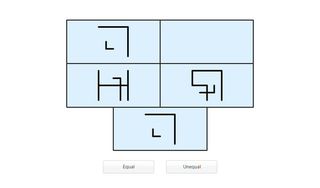
What is the FEAST cube folding test?

The FEAST cube folding test is not necessarily one single official module used identically by every FEAST organization. In FEAST preparation, “cube folding test” usually refers to a spatial reasoning task type where candidates mentally fold a flat cube net into a three-dimensional cube.

Cube folding is useful for air traffic controller selection preparation because it trains visual-spatial reasoning, mental rotation, orientation, and precision under time pressure.

A cube folding task may ask you to decide:

  • which cube can be made from a flat net
  • which faces are opposite
  • which faces can touch
  • which markings can appear together
  • whether a rotated cube matches the net
  • whether an answer option is impossible

The exact FEAST task format depends on the ANSP, academy, university, or recruiter using FEAST. Always follow official instructions from the organization that invited you.

Why cube folding matters for FEAST preparation

Cube folding trains the ability to visualize objects in three dimensions.

That matters because FEAST-style spatial reasoning may involve:

  • mental rotation
  • orientation
  • position relationships
  • visual comparison
  • movement prediction
  • dynamic tracking
  • spatial awareness under time pressure

You do not need professional ATC knowledge to practice cube folding. The goal is to build flexible visual-spatial thinking.

Related page: FEAST spatial reasoning test

What is a cube net?

A cube net is a flat arrangement of six squares that can fold into a cube.

Each square becomes one face of the cube.

A simple cube net might look like a cross shape:

    A
B   C   D   E
    F

When folded, the squares become the six faces of a cube.

The challenge is to imagine which faces touch, which faces are opposite, and how the cube looks after rotation.

Core concept 1: opposite faces

Opposite faces are faces that do not touch each other on the folded cube.

If two faces are opposite, they cannot share an edge.

Example:

If A is opposite F, A and F cannot touch along an edge.

This is one of the fastest ways to eliminate wrong answer choices.

In many cube folding tasks, you do not need to visualize the whole cube immediately. You can often eliminate impossible options by identifying opposite faces.

Core concept 2: shared edges

Two faces share an edge if they touch along one side of the cube.

In a cube net, squares that are directly adjacent often become adjacent faces when folded, but not every visual relationship in the flat net is obvious after folding.

You need to track:

  • which faces are next to each other
  • which faces wrap around the cube
  • which faces are opposite
  • which markings should meet at an edge
  • which answer choices show impossible adjacency

Shared edge reasoning is central to cube folding accuracy.

Core concept 3: rotation

A folded cube can be rotated.

This means the same cube may look different depending on the viewing angle.

Do not reject an answer just because the cube appears turned. Ask:

  • Could this be the same cube after rotation?
  • Are the same faces adjacent?
  • Are opposite faces still opposite?
  • Do the markings keep the same relationships?
  • Is the orientation of each marked face possible?

Rotation is allowed; mirroring is usually not.

Core concept 4: rotation vs reflection

A common cube folding mistake is confusing a rotated cube with a mirrored cube.

A rotated cube keeps the same face relationships.

A mirrored cube reverses relationships and may be impossible.

When comparing answer options, ask:

  • Is this just the same cube turned?
  • Or has the face order been mirrored?
  • Are the adjacent faces in the correct order?
  • Do markings point the right way after rotation?

This distinction is often the difference between a correct and incorrect answer.

Core concept 5: face orientation

Some cube folding tasks use arrows, letters, lines, dots, or shapes on faces.

It is not enough to know which faces touch. You may also need to know how the markings are oriented.

For example:

  • an arrow may point toward a shared edge
  • a line may continue across two faces
  • a symbol may be rotated
  • a letter may appear upside down
  • dots may occupy specific corners

Face orientation makes cube folding harder because you must track both face position and marking direction.

Cube folding in FEAST Part 1

Cube folding is most naturally connected with FEAST Part 1, because FEAST Part 1 is commonly associated with foundational cognitive and spatial reasoning tests.

Cube folding can support preparation for:

  • spatial reasoning
  • visual relationships
  • mental rotation
  • shape comparison
  • orientation
  • attention to detail
  • timed accuracy

Related page: FEAST Part 1

Cube folding and spatial reasoning

Cube folding is one type of spatial reasoning.

Other spatial reasoning tasks may include:

  • mental rotation
  • map orientation
  • direction changes
  • shape comparison
  • perspective switching
  • movement prediction
  • dynamic tracking

If cube folding feels hard, do not assume you are bad at all spatial reasoning. Break the skill down into smaller parts.

Related page: FEAST spatial reasoning test

How to solve cube folding questions

A practical cube folding method:

  1. Identify the center face or anchor face.
  2. Identify faces directly adjacent to it.
  3. Identify opposite face pairs.
  4. Track any special markings.
  5. Compare answer options.
  6. Eliminate impossible opposite-face adjacencies.
  7. Check shared edges.
  8. Check rotation vs reflection.
  9. Check symbol orientation if needed.
  10. Choose the option that preserves all relationships.

Do not try to visualize everything at once if the task feels complex. Use elimination.

Strategy 1: find opposite faces first

Opposite faces are powerful.

If an answer option shows two opposite faces touching, it is impossible.

Example:

A is opposite D.
An answer option shows A and D sharing an edge.
That option is impossible.

This strategy saves time because you can eliminate wrong answers quickly.

Strategy 2: use one anchor face

Choose one face as the anchor.

Then ask:

  • what is above it?
  • what is below it?
  • what is left of it?
  • what is right of it?
  • what face folds behind it?
  • what face is opposite it?

Anchoring prevents mental chaos.

Strategy 3: track edge relationships

If two faces share an edge in the final cube, their relationship should make sense from the net.

For marked faces, pay attention to which side of a face touches another face.

Example:

If an arrow points toward Face B in the net, it should still point toward the shared edge with Face B after folding.

Edge tracking is especially important when markings are directional.

Strategy 4: eliminate impossible options

You do not always need to prove the correct option immediately.

Eliminate options that violate:

  • opposite face rules
  • impossible adjacency
  • wrong marking orientation
  • mirrored face order
  • missing face relationships
  • impossible shared edges

After elimination, the correct answer may become clear.

Strategy 5: practice slowly before adding timing

Cube folding is difficult if you add time pressure too early.

Use this progression:

  1. Learn cube nets slowly.
  2. Identify opposite faces.
  3. Identify adjacent faces.
  4. Practice with unmarked faces.
  5. Add markings.
  6. Add rotated answer options.
  7. Add timing gradually.
  8. Review mistakes.

Accuracy comes before speed.

Sample cube folding question 1: opposite faces

This is original practice, not official FEAST content.

A cube has these opposite face pairs:

A opposite D
B opposite E
C opposite F

Can Face A touch Face D along an edge?

Answer:

No.

Explanation:

Opposite faces cannot share an edge.

Sample cube folding question 2: possible adjacency

A cube has these opposite face pairs:

A opposite D
B opposite E
C opposite F

Can Face A touch Face B?

Answer:

Yes.

Explanation:

A and B are not opposite faces, so they may be adjacent.

Sample cube folding question 3: elimination

A cube has these opposite face pairs:

Top opposite Bottom
Left opposite Right
Front opposite Back

An answer option shows Top, Bottom, and Front all visible together.

Is the option possible?

Answer:

No.

Explanation:

Top and Bottom are opposite faces, so they cannot be visible together on adjacent sides of the same cube view.

Sample cube folding question 4: rotation

A cube shows faces A, B, and C meeting at one corner.

Another answer option shows the same three faces meeting at one corner, but the cube is turned.

Could it be the same cube?

Answer:

Yes, if the face order and orientations are preserved.

Explanation:

A cube can be rotated. Rotation alone does not make an option wrong.

Sample cube folding question 5: reflection

A cube shows faces A, B, and C meeting in clockwise order around a corner.

Another option shows A, C, and B in the reversed order around the same corner.

Could this be a mirrored option?

Answer:

Yes.

Explanation:

Reversing the order of faces may indicate reflection rather than rotation, depending on the layout.

How to practice cube folding

A good cube folding practice session should include:

  • identifying opposite faces
  • identifying adjacent faces
  • folding simple nets mentally
  • comparing answer options
  • detecting impossible cubes
  • checking marking orientation
  • distinguishing rotation from reflection
  • timed practice after accuracy improves
  • reviewing every mistake

Do not only count correct answers. Study why wrong options are impossible.

One-week FEAST cube folding preparation plan

If you have one week, focus on fundamentals.

Day 1: cube net basics

Learn what cube nets are and identify faces.

Day 2: opposite faces

Practice finding opposite face pairs quickly.

Day 3: adjacent faces

Practice identifying which faces can touch.

Day 4: mental folding

Practice folding simple nets without markings.

Day 5: marked faces

Practice arrows, dots, letters, and face orientation.

Day 6: timed mixed practice

Add timing and review errors.

Day 7: light review

Review common mistakes and rest.

Two-week FEAST cube folding preparation plan

If you have two weeks, build more gradually.

Days 1–2: net recognition

Practice identifying valid cube nets and face positions.

Days 3–5: opposite and adjacent faces

Drill face relationships until they become faster.

Days 6–8: mental folding

Practice folding nets and rotating cubes mentally.

Days 9–10: marking orientation

Practice arrows, symbols, dots, and lines on faces.

Days 11–12: rotation vs reflection

Practice distinguishing rotated cubes from mirrored cubes.

Day 13: timed mixed set

Complete timed cube folding practice and review mistakes.

Day 14: light review

Avoid heavy cramming and protect sleep.

Common cube folding mistakes

Avoid these mistakes:

  • trying to visualize the whole cube at once
  • ignoring opposite faces
  • confusing rotation with reflection
  • assuming all nearby net faces touch after folding
  • missing symbol orientation
  • rushing before understanding the net
  • practicing only unmarked cubes
  • adding time pressure too early
  • not reviewing why wrong answers are wrong
  • assuming cube folding cannot improve
  • relying on unofficial “exact FEAST” claims

Cube folding improves through methodical practice.

How to review cube folding mistakes

After each mistake, ask:

  • Did I identify opposite faces correctly?
  • Did I assume two faces touched when they did not?
  • Did I confuse rotation with reflection?
  • Did I miss a symbol orientation issue?
  • Did I rotate the cube the wrong way?
  • Did I fail to use an anchor face?
  • Did timing make me guess?
  • Did I eliminate too quickly?
  • Did I misunderstand the net?

Mistake review is where spatial improvement happens.

Cube folding and time pressure

Cube folding can be slow at first.

That is normal.

Do not begin by forcing maximum speed. Instead:

  1. solve slowly and accurately
  2. identify the method
  3. repeat with new examples
  4. add a light timer
  5. reduce time gradually
  6. practice elimination
  7. review errors

Speed improves when face relationships become automatic.

Cube folding and test-day performance

On test day:

  • read the instruction carefully
  • identify the net
  • find opposite faces
  • use an anchor face
  • eliminate impossible options
  • check rotation vs reflection
  • check markings if present
  • avoid panic guessing
  • move on if stuck
  • recover after difficult items

One difficult cube folding item should not disrupt the rest of the test.

Ethical preparation

Prepare ethically.

Avoid:

  • leaked FEAST cube folding items
  • screenshots from real test sessions
  • copied official content
  • unauthorized question banks
  • claims of exact official replication
  • sharing protected test details after your session

Practice cube folding as a skill, not as confidential test-content memorization.

What to verify officially

Before taking FEAST, verify:

  • whether you are invited to the test
  • test date
  • location or online method
  • required identification
  • expected duration
  • allowed and prohibited items
  • whether official familiarization material is provided
  • result communication process
  • retake policy
  • contact information for questions

If this guide conflicts with your ANSP, recruiter, academy, university, EUROCONTROL, or test-session instructions, follow the official source.

Bottom line

FEAST cube folding preparation should focus on 3D visualization, cube nets, opposite faces, adjacent faces, shared edges, mental rotation, marking orientation, and elimination strategy.

Build accuracy first, add timing gradually, review mistakes carefully, and avoid unauthorized test content. The goal is flexible spatial reasoning under pressure.

Preparation resources

Free orientation should stay realistic about what your recruiting organization actually uses. Paid catalogs vary by pathway, so match modules to your official instructions before spending money.

You may compare these catalog corners from the same publisher (none are official EUROCONTROL or employer materials): FEAST 2–oriented notes, FAA ATSA–oriented prep for cross-pathway research, and general ATC aptitude pages. Publisher: JobTestPrep.

You may also find our JobTestPrep FEAST Review helpful before buying.

Frequently asked questions

Comparing paid prep (optional)

If you want structured vendor content, you may review FEAST-style practice or EUROCONTROL-oriented FEAST prep from JobTestPrep. Always confirm which package matches your campaign before purchasing.

Is cube folding part of FEAST?

Cube folding is commonly used as a spatial reasoning practice topic for FEAST-style preparation. Exact modules depend on the organization using FEAST.

What does cube folding test?

Cube folding tests 3D visualization, mental rotation, face relationships, opposite faces, shared edges, and spatial accuracy.

How do I get better at cube folding?

Practice identifying opposite faces, adjacent faces, anchor faces, rotation, reflection, and symbol orientation. Add timing only after accuracy improves.

What is the fastest cube folding strategy?

Find opposite faces first, then eliminate answer options that show impossible face adjacencies.

What is the biggest cube folding mistake?

A common mistake is confusing a mirrored cube with a rotated cube.

Should I memorize cube folding answers?

No. Memorize the method, not individual answers. Practice varied cube nets and review why options are impossible.

Can cube folding ability improve?

Yes. Cube folding improves with structured practice, visualization, elimination strategy, and mistake review.