
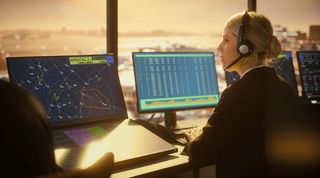
What spatial reasoning means in ATSA preparation
Spatial reasoning is the ability to understand visual information, positions, directions, movement, and relationships between objects.
In ATSA preparation, candidates often study spatial reasoning because air traffic control work requires comfort with changing positions, movement, and visual-spatial awareness. The ATSA itself should not be treated as real air traffic control training, but spatial ability is still an important aptitude area to practice.
Spatial reasoning tasks may feel different from ordinary school questions. Instead of recalling facts, you may need to interpret visual relationships quickly and accurately.
Why spatial reasoning matters
Air traffic control is a visual and spatially demanding career path. Controllers must learn to think about movement, relative position, direction, and changing situations.
ATSA-style spatial reasoning practice may help candidates build comfort with:
- object position
- direction
- movement
- visual relationships
- mental rotation
- relative location
- pattern comparison
- conflict-style judgment
- speed and accuracy under pressure
You do not need to know professional ATC procedures to practice these skills. The goal is general aptitude preparation, not operational training.
Spatial reasoning is not aviation memorization
A common mistake is assuming that spatial reasoning preparation means studying aviation charts, runway diagrams, phraseology, or separation standards.
That is not the right focus for ATSA preparation.
Spatial reasoning is about how you process visual relationships. It is not about memorizing technical aviation knowledge.
Useful preparation should help you answer questions such as:
- Which object is left or right of another?
- Which direction is something moving?
- How would this shape look if rotated?
- Are two paths getting closer or farther apart?
- Which option matches the visual pattern?
- Which object relationship changed?
Those are general cognitive skills, not professional controller procedures.
Common spatial reasoning task types
Independent preparation resources may describe spatial reasoning in different ways. These labels are useful for study planning, but they should not be treated as official ATSA section names unless confirmed by authorized materials.
Common spatial reasoning practice areas include:
- mental rotation
- visual relationship questions
- direction and orientation
- map-style reasoning
- movement tracking
- pattern comparison
- object position
- conflict or collision-style judgment
A complete preparation plan should include more than one type of visual-spatial practice.
Mental rotation
Mental rotation tasks ask you to imagine how a shape, object, or pattern would look after being turned.
These tasks can feel difficult if you try to solve them only by verbal reasoning. You may need to visualize the object and compare key features.
Practice tips:
- identify a fixed feature first
- rotate the object mentally in small steps
- compare orientation, not just shape
- watch for mirror images
- avoid rushing before checking details
- practice with simple shapes before complex ones
Mental rotation improves with exposure and careful review.
Direction and orientation
Direction and orientation tasks involve understanding where something is pointing or moving.
Practice may include:
- left/right relationships
- up/down orientation
- compass-like direction
- relative position
- object movement
- rotation direction
- changes in viewpoint
The challenge is often avoiding confusion when the frame of reference changes. What looks like “left” from one perspective may not stay left from another perspective.
Visual relationship questions
Visual relationship tasks ask you to compare how objects relate to each other.
You may need to notice:
- position
- size
- direction
- spacing
- order
- overlap
- pattern
- movement
- change over time
These tasks reward careful scanning. Many errors happen when candidates focus on one feature and miss another.
Movement tracking
Movement tracking is especially relevant to ATSA-style preparation because some tasks may involve objects changing position.
Practice may involve asking:
- Which objects are moving toward each other?
- Which path may cross another path?
- Which object is changing direction?
- Which object is closest?
- Which movement pattern matters under the rule?
Movement tracking overlaps with attention and decision-making. It is not only spatial reasoning; it also requires focus under time pressure.
Collision simulation-style reasoning
Some candidates study collision simulation or conflict-detection style tasks as part of ATSA preparation.
These tasks may involve judging whether moving objects could intersect or come into conflict based on a rule.
Important: this is not real air traffic control training. It is aptitude-style practice.
For a deeper explanation, read ATSA collision simulation explained.
Why spatial reasoning can feel hard
Spatial reasoning can feel difficult for several reasons:
- the tasks are unfamiliar
- objects may look similar
- timing creates pressure
- small visual differences matter
- mirror images can be confusing
- movement changes quickly
- candidates rush before understanding the rule
- anxiety reduces careful observation
Some candidates are naturally comfortable with spatial tasks. Others improve only after repeated practice.
If spatial reasoning is hard for you, that does not mean you cannot improve. It means you need targeted practice.
How to practice spatial reasoning
Start with untimed practice
Begin without a timer. Make sure you understand the task type before adding speed.
If you miss many questions at the beginning, the issue may be task familiarity rather than ability.
Learn the rule first
Before solving, ask:
- What am I comparing?
- What changes?
- What stays the same?
- Is rotation involved?
- Is direction involved?
- Is movement involved?
- What counts as the correct answer?
This prevents careless mistakes.
Add timing gradually
Once you understand the task, add time limits.
Timing should increase pressure without destroying accuracy. If timed practice causes too many errors, reduce difficulty and rebuild.
Review visual mistakes
After practice, do not only check whether you were right or wrong.
Ask:
- Did I miss a small detail?
- Did I confuse rotation with reflection?
- Did I misread direction?
- Did I focus on the wrong object?
- Did I rush?
- Did I misunderstand the rule?
This review helps you improve faster.
Practice routine for spatial reasoning
Here is a simple routine:
Session 1 - Visual comparison
Practice comparing shapes or patterns. Focus on accuracy.
Session 2 - Mental rotation
Practice rotating simple objects. Watch for mirror-image traps.
Session 3 - Direction and orientation
Practice relative position and direction tasks.
Session 4 - Movement tracking
Practice following moving objects or changing positions.
Session 5 - Timed mixed practice
Combine visual comparison, rotation, direction, and movement with light timing.
Keep sessions short and focused. Spatial reasoning can become tiring if practiced for too long without review.
Speed vs accuracy
Spatial reasoning tasks can create a speed-accuracy tradeoff.
If you move too fast, you may miss a small visual detail. If you move too slowly, timing may become a problem.
A good strategy is:
- understand the rule
- identify the key visual feature
- eliminate obviously wrong options
- check the most confusing detail
- answer and move on
Do not try to make every answer feel perfect. But do not rush blindly.
How spatial reasoning connects to other ATSA skills
Spatial reasoning overlaps with several other preparation areas.
Attention
You need attention to notice the right visual detail.
Memory
Some tasks may require you to remember a visual pattern or rule.
Multitasking
You may need to monitor movement while applying another rule.
Collision simulation
Conflict-style tasks depend heavily on spatial judgment.
Test-day discipline
You need to stay calm when a visual task feels unfamiliar.
This is why spatial reasoning should not be practiced in isolation forever. Eventually, mix it with other skills.
Common spatial reasoning mistakes
Avoid these mistakes:
- practicing only untimed questions
- ignoring mirror images
- confusing left/right from different perspectives
- rushing before reading instructions
- memorizing examples instead of learning the skill
- avoiding spatial practice because it feels difficult
- assuming spatial reasoning is the same as aviation knowledge
- using only one type of visual task
- failing to review errors
The goal is flexible visual reasoning, not memorization.
Test-day tips for spatial tasks
If you encounter spatial reasoning tasks on test day:
- read the instructions carefully
- identify what changes and what stays the same
- watch for mirror images
- do not overfocus on one feature
- pace yourself
- recover quickly from mistakes
- avoid assuming the task matches your practice exactly
- focus on the current item
Stay calm. Spatial tasks often become harder when anxiety makes you rush.
Bottom line
ATSA spatial reasoning preparation should train your ability to interpret position, direction, movement, rotation, and visual relationships under pressure.
You do not need official test content to practice these skills. Use honest, varied spatial reasoning exercises, add timing gradually, review mistakes carefully, and connect spatial practice with broader ATSA preparation.
For the next step, review ATSA question types explained and How to prepare for the ATSA.
Optional vendor shortcuts (commercial)
If you want optional paid prep aligned with this page topic, compare these options:
- ATSA Practice Tests
- Spatial-focused drills: ATC Preparation FEAST software and SkyTest FEAST European ATCO
- JobTestPrep ATSA course
- ATC Preparation ATSA software
- ATC Preparation ATSA personality test
- JobTestPrep ATC aptitude catalog
Use review-first comparison: Best ATSA Practice Tests, ATSA Practice Tests Review, JobTestPrep ATSA Review, ATC Preparation Review, and SkyTest Review.
Preparation resources
Free resources are a good starting point if you are still learning the format. If you add paid material later, compare calmly and read refund rules on the publisher’s site.
For ATSA-only commercial practice, start with ATSA Practice Tests. The vendor publishes 10 ATSA-aligned training modules, timed Full Simulations, and a Performance Center, with a one-time 90-day access window. Confirm live pricing, access terms, and refund rules on the vendor site. It is independent and not affiliated with the FAA.
If your research widens beyond the FAA pathway, these third-party catalogs may still be worth a quick skim (none are official FAA, Pearson VUE, or USAJOBS materials): FEAST-style practice content, NAV CANADA-oriented prep, and notes aimed at later FEAST stages. Publisher: JobTestPrep.
For interactive ATSA-style training, you may also review ATC Preparation ATSA software and our ATC Preparation Review. Verify pathway fit on the vendor site before purchasing.
If your research widens to FEAST pathways, see our SkyTest Review and SkyTest® products: European ATCO screenings, UK & Ireland, and Germany, Austria & Switzerland - none are official FAA materials.
You can also compare paid products using our ATSA Practice Tests Review, JobTestPrep ATSA Review, Best ATSA Practice Tests, and the Reviews hub.