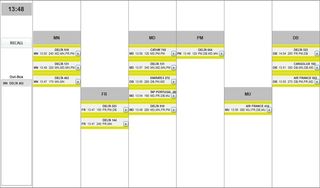
What is the FEAST dynamic radar test?
The FEAST dynamic radar test is not necessarily one single official module used identically by every organization. In FEAST preparation, this term usually refers to radar-style or dynamic monitoring tasks that may appear in FEAST-style air traffic controller selection.
These tasks may involve moving objects, changing positions, possible conflicts, visual tracking, rule application, and time-sensitive decisions.
FEAST, the First European Air Traffic Controller Selection Test, is a EUROCONTROL-developed test battery used by participating air navigation service providers, academies, universities, and aviation training organizations.
Because official FEAST content is controlled by the organization using the test, candidates should be cautious with any resource that claims to show the exact dynamic radar task. This page explains the preparation concepts ethically and generally.
Why dynamic radar-style tasks matter
Air traffic control is a dynamic profession.
Aircraft move. Traffic situations change. Controllers must maintain awareness, detect developing issues, prioritize, and make decisions while information keeps updating.
A dynamic radar-style assessment does not require you to already know professional ATC procedures. Instead, it may test abilities such as:
- spatial awareness
- movement tracking
- conflict detection
- visual scanning
- attention switching
- prioritization
- rule application
- reaction accuracy
- workload control
- decision-making under pressure
The goal is to assess relevant cognitive abilities, not to train you as an operational radar controller.
Dynamic radar and FEAST Part 2
Dynamic radar-style tasks are most naturally connected with FEAST Part 2, or FEAST II, because FEAST II is commonly associated with more complex multitasking and dynamic task performance.
FEAST Part 1 often focuses on foundational cognitive abilities and English language testing. FEAST Part 2 may require candidates to apply multiple abilities at once in a more active environment.
Related pages:
Dynamic radar is not operational ATC
A dynamic radar-style FEAST task may look aviation-related, but it is not the same as real air traffic control.
You generally do not need to know:
- actual radar separation standards
- ATC phraseology
- airspace classifications
- professional vectoring techniques
- coordination procedures
- facility-specific rules
- real-world radar control methods
Unless your recruiting organization specifically tells you otherwise, prepare for the cognitive task demands, not for professional controller procedures.
Core skill 1: moving-object tracking
Moving-object tracking means following objects as they change position.
You may need to monitor:
- where an object is now
- where it is heading
- how fast it is moving
- whether it is turning
- whether it is getting closer to another object
- whether it is moving away from risk
- whether it may cross another path
Tracking movement requires continuous updating, not a one-time observation.
Core skill 2: conflict detection
Conflict detection means identifying when two or more moving objects may become a problem under the task rules.
In practice, this may involve noticing:
- objects moving toward each other
- crossing paths
- decreasing distance
- converging directions
- similar arrival times at the same point
- high-priority objects
- rapidly changing risk
The exact definition of a conflict depends on the test instructions. Do not assume real ATC separation rules unless instructed.
Core skill 3: relative position
Relative position means understanding how objects relate to each other.
You may need to identify:
- which object is closest
- which pair is converging
- which object is behind another
- which object is ahead
- which object is moving faster
- which object will reach a point first
- which object is moving away
- which object requires immediate attention
Related page: FEAST spatial reasoning test
Core skill 4: visual scanning
Dynamic displays can become busy.
Visual scanning helps you avoid missing important changes.
Good scanning means:
- checking the whole display
- identifying high-risk areas
- returning to important objects
- avoiding tunnel vision
- noticing new changes
- keeping secondary items in awareness
A random scan pattern can cause missed conflicts.
Related page: FEAST attention test
Core skill 5: prioritization
Dynamic radar-style tasks may show more than one possible issue.
You may need to decide what matters first.
Priority may depend on:
- urgency
- distance
- closing speed
- time to conflict
- object type
- rule hierarchy
- risk level
- whether an event is already developing
- whether another item can wait
A common mistake is responding to the most visible object rather than the highest-risk object.
Core skill 6: rule application
The test instructions may define what you should do.
Rules may explain:
- when a conflict exists
- when to respond
- what response to choose
- what to ignore
- which item has priority
- whether action can be changed
- what counts as an error
- how timing is handled
Read the instructions carefully. Dynamic tasks often become difficult because candidates forget rules after the display starts moving.
Core skill 7: workload control
Workload control means staying functional when the display becomes busy.
Good workload control includes:
- calm scanning
- controlled responses
- prioritization
- ignoring irrelevant movement
- avoiding overchecking
- recovering after mistakes
- maintaining accuracy
- continuing under pressure
Dynamic tasks reward steadiness.
How to prepare for FEAST dynamic radar tasks
A good preparation plan should build from simple spatial awareness to dynamic multitasking.
Use this progression:
- Practice direction and orientation.
- Practice movement prediction.
- Practice two-object tracking.
- Practice multiple-object tracking.
- Practice conflict detection.
- Add rule-based responses.
- Add priority rules.
- Add timing.
- Add multitasking.
- Review mistakes carefully.
Do not jump straight into complex simulated radar tasks before you can track simple movement accurately.
Step 1: practice direction and orientation
Start with basic movement language.
Practice:
- north, south, east, west
- left, right
- clockwise, counterclockwise
- toward, away
- crossing, parallel
- above, below
- ahead, behind
- faster, slower
These concepts need to feel automatic.
Step 2: practice movement prediction
Movement prediction is central to dynamic radar-style tasks.
Ask:
- where is the object going?
- will it cross another path?
- is it moving toward a risk?
- is it moving away from another object?
- which object will reach a point first?
- is the distance increasing or decreasing?
Prediction helps you act before a situation becomes obvious.
Step 3: practice two-object tracking
Start with two moving objects.
Example:
Object A moves east.
Object B moves west.
They are on the same horizontal line.
Question:
Are they converging or diverging?
Answer:
Converging.
Two-object tracking builds the foundation for more complex displays.
Step 4: practice multiple-object tracking
After two-object tracking becomes comfortable, add more objects.
The main challenge becomes prioritization.
Do not try to watch every object equally. Instead:
- scan all objects
- identify pairs getting closer
- monitor the highest-risk pair
- return to the full display
- update priorities as movement changes
Step 5: add conflict rules
Practice with simplified conflict rules.
Example:
If two objects are moving toward the same point, mark WATCH.
If two objects are moving away from each other, ignore.
If one object will cross another path soon, mark CHECK.
These are practice examples only, not official FEAST rules.
The goal is rule-based dynamic reasoning.
Step 6: add timing
Timing should be added gradually.
Use this progression:
- Understand the task.
- Practice slowly.
- Improve accuracy.
- Add a generous timer.
- Reduce time gradually.
- Increase object count.
- Add priority rules.
- Review errors.
Do not train panic. Train controlled urgency.
Step 7: add multitasking
Dynamic radar-style tasks may overlap with multitasking.
You may need to track movement while also monitoring alerts, values, symbols, or rules.
Add multitasking only after basic dynamic tracking is stable.
Related page: FEAST multitasking test
Sample dynamic radar-style practice
This is an original practice concept, not official FEAST content.
Scenario
A is moving east.
B is moving west.
C is moving north.
D is moving east, parallel to A.
A and B are on the same horizontal line.
C is below both and moving away from them.
D is far above A and moving in the same direction as A.
Question
Which pair should you monitor most closely?
Answer
A and B.
Explanation
A and B are moving toward each other on the same line, so they create the most obvious convergence in this simplified scenario.
Sample rule-based dynamic practice
This is an original practice concept, not official FEAST content.
Rules
If two objects are moving toward each other, mark WATCH.
If two objects are moving away from each other, ignore.
If two objects are moving in parallel, mark SAFE unless their distance is decreasing.
Scenario
A and B are moving toward each other.
C and D are moving in parallel at the same distance.
E and F are moving away from each other.
Correct response
A/B = WATCH
C/D = SAFE
E/F = Ignore
Dynamic radar and tunnel vision
Tunnel vision is a major risk.
Tunnel vision happens when you focus too long on one object or pair and miss changes elsewhere.
To reduce tunnel vision:
- scan the whole display
- identify high-risk pairs
- return to the full picture after responding
- use a repeated scan pattern
- avoid staring at one object
- practice with multiple moving items
- review missed-event mistakes
Dynamic radar and reaction speed
Reaction speed matters, but only after you understand the rule.
Do not respond just because something looks urgent.
Before responding, confirm:
- what the rule says
- whether the objects are actually relevant
- whether priority applies
- whether another item is more urgent
- whether the response is required now
Controlled response beats impulsive response.
Related page: FEAST reaction time test
Dynamic radar and memory
Memory helps you remember rules and recent changes.
You may need to remember:
- which items were moving toward each other
- which pair was already checked
- which rules apply
- what priority order matters
- which object changed direction
- what the task asked you to ignore
Related page: FEAST memory test
Dynamic radar and English comprehension
Even visual tasks require instruction comprehension.
Important words may include:
- toward
- away
- converging
- diverging
- crossing
- parallel
- nearest
- farthest
- before
- after
- unless
- ignore
- priority
- conflict
- respond
If English is not your strongest language, practice reading rule-based instructions under time pressure.
Related page: FEAST English test
One-week dynamic radar preparation plan
If you have one week, focus on fundamentals.
Day 1: understand dynamic tasks
Read about FEAST Part 2, DART, and dynamic radar-style concepts.
Day 2: direction and orientation
Practice movement language and relative position.
Day 3: movement prediction
Practice predicting paths and identifying convergence.
Day 4: multiple-object tracking
Practice scanning several moving items.
Day 5: conflict rules
Practice simplified rule-based dynamic tasks.
Day 6: timed dynamic practice
Add timing and review mistakes carefully.
Day 7: light review
Rest, review official instructions, and protect sleep.
Two-week dynamic radar preparation plan
If you have two weeks, build progressively.
Days 1–2: foundation
Practice direction, orientation, and spatial basics.
Days 3–5: movement prediction
Practice moving-object tracking and path crossing.
Days 6–8: multiple-object displays
Practice scanning and prioritization.
Days 9–11: rule-based dynamic tasks
Add conflict rules, exceptions, and priorities.
Days 12–13: timed mixed sessions
Combine dynamic tracking, multitasking, and reaction accuracy.
Day 14: final readiness
Light practice, logistics, and sleep.
Common dynamic radar preparation mistakes
Avoid these mistakes:
- trying to learn real ATC procedures instead of task skills
- relying on exact-copy claims
- watching one object too long
- ignoring the full display
- reacting before applying rules
- missing priority changes
- adding timing too early
- failing to review missed conflicts
- practicing only static spatial reasoning
- overtraining before test day
- using leaked or unauthorized content
Good preparation trains movement awareness and rule-based decision-making.
How to review mistakes
After each dynamic practice session, ask:
- Did I track direction correctly?
- Did I misjudge speed?
- Did I miss convergence?
- Did I ignore a crossing path?
- Did I focus on the wrong pair?
- Did I forget a rule?
- Did I respond too early?
- Did I respond too late?
- Did I lose the full picture?
- Did fatigue affect scanning?
Then target the cause with specific drills.
Ethical preparation
Prepare ethically.
Avoid:
- leaked FEAST dynamic radar items
- screenshots from real test sessions
- copied official content
- unauthorized question banks
- claims of exact official replication
- sharing protected test details after your session
Practice the underlying abilities, not confidential test content.
What to verify officially
Before taking FEAST, verify:
- whether you are invited to the relevant stage
- test date
- location or online method
- required identification
- expected duration
- allowed and prohibited items
- whether official familiarization material is provided
- result communication process
- retake policy
- contact information for questions
If this guide conflicts with your ANSP, recruiter, academy, university, EUROCONTROL, or test-session instructions, follow the official source.
Bottom line
FEAST dynamic radar preparation should focus on moving-object tracking, conflict detection, spatial awareness, visual scanning, prioritization, rule application, and workload control.
Do not try to memorize unofficial task descriptions or learn real ATC procedures unnecessarily. Practice the underlying cognitive skills, review mistakes carefully, and follow official instructions from the organization that invited you.
Preparation resources
Free orientation should stay realistic about what your recruiting organization actually uses. Paid catalogs vary by pathway, so match modules to your official instructions before spending money.
You may compare these catalog corners from the same publisher (none are official EUROCONTROL or employer materials): FEAST 2–oriented notes, FAA ATSA–oriented prep for cross-pathway research, and general ATC aptitude pages. Publisher: JobTestPrep.
You may also find our JobTestPrep FEAST Review helpful before buying.
Frequently asked questions
Comparing paid prep (optional)
If you want structured vendor content, you may review FEAST-style practice or EUROCONTROL-oriented FEAST prep from JobTestPrep. Always confirm which package matches your campaign before purchasing.
Is there a FEAST dynamic radar test?
Dynamic radar-style tasks are commonly discussed in FEAST preparation, especially in relation to FEAST Part 2 and DART-style task concepts. Exact modules depend on the organization using FEAST.
What does a dynamic radar-style task test?
It may test moving-object tracking, conflict detection, spatial awareness, visual scanning, prioritization, rule application, and decision-making under pressure.
Do I need real ATC knowledge for dynamic radar tasks?
Usually no, unless your recruiting organization specifically says otherwise. Focus on task instructions and cognitive skills.
How should I practice dynamic radar tasks?
Practice direction, movement prediction, two-object tracking, multiple-object tracking, conflict detection, rule application, timing, and mistake review.
Is DART the same as a dynamic radar task?
DART is commonly discussed as a dynamic radar-style FEAST task concept, but candidates should verify their exact test process with the organization that invited them.
What is the biggest mistake in dynamic radar tasks?
A common mistake is tunnel vision: focusing on one object or pair too long and missing changes elsewhere.
Should I prioritize speed or accuracy?
Both matter, but accuracy and rule application should come first. Build speed gradually after you understand the task.

